
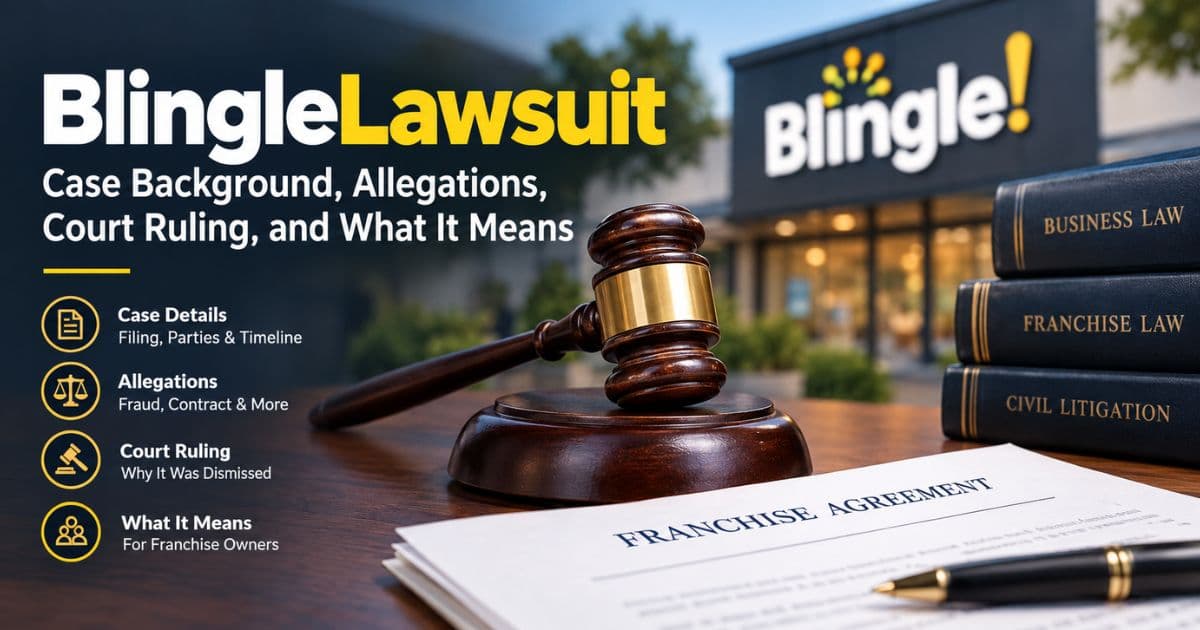
The keyword BlingleLawsuit has attracted attention from people researching business disputes, franchise agreements, and the legal history of Blingle! and its associated companies. Readers searching for this term generally want to understand what happened, who was involved, what claims were made, and how the legal proceedings ended.
The term is commonly used online to describe a federal franchise dispute involving businesses associated with Blingle! and Horse Power Brands. The formal case name was Waldron et al. v. SVHB Marketing LLC d/b/a Horse Power Brands et al., filed in the U.S. District Court for the Eastern District of Pennsylvania. The distinction between the online search term and the official case name is important when researching reliable legal information.
Legal disputes can be complicated, especially when they involve multiple franchise owners, business entities, contractual obligations, and allegations concerning business practices. Understanding the BlingleLawsuit therefore requires looking at the background of the franchise relationship, the claims reported in the case, and the court’s actual ruling rather than relying exclusively on headlines or social media posts.
This guide explains the publicly reported case history in accessible language. It also explores why franchise agreements matter, how mediation requirements work, and what prospective franchise owners can learn from reviewing legal records before making a business investment.
What Is BlingleLawsuit?
BlingleLawsuit is a search term associated with a federal legal dispute involving Blingle!-related franchise businesses and entities connected with Horse Power Brands. The case arose from disagreements related to franchise relationships rather than a general consumer class action concerning ordinary purchases of lighting services.
The underlying proceeding was identified as Waldron et al. v. SVHB Marketing LLC d/b/a Horse Power Brands et al. Public case summaries identify it as a franchise contract dispute filed in September 2023. The lawsuit included multiple plaintiffs and defendants, making it more complex than a dispute between two individual parties.
When researching this subject, readers should distinguish between three different types of information:
- Verified procedural facts: Information such as the case number, court, filing date, and dismissal.
- Party allegations: Claims made by plaintiffs in their legal complaint that may not have been established as facts.
- Commentary and interpretation: Explanations published by websites, commentators, or other third parties.
These distinctions are important because filing a lawsuit does not automatically establish wrongdoing. Similarly, a procedural dismissal does not necessarily establish that every allegation was false.
Understanding the Official Case Name
The formal case name is more useful than the keyword BlingleLawsuit when looking for court documents. Legal databases organize proceedings by their official captions, docket numbers, and court information rather than by popular search phrases.
The operative federal case is associated with Case No. 2:23-cv-03485-MSG in the Eastern District of Pennsylvania. Readers can use those details to distinguish this proceeding from unrelated business disputes or older filings that may appear in search results.
Searching the official case name also helps readers find more precise information about motions, court orders, and the procedural history. It reduces the risk of confusing allegations repeated in blog articles with statements contained in actual legal documents.
Background of Blingle! and Horse Power Brands
Blingle! is associated with the outdoor lighting and lighting-services franchise industry. Services in this market can include decorative holiday lighting, landscape illumination, permanent outdoor lighting systems, and lighting installations for residential or commercial properties.
A franchise arrangement generally allows an independent business owner to operate using a brand’s established business model, subject to the terms of a franchise agreement. Depending on the agreement, the franchise relationship may include an initial fee, continuing royalties, marketing contributions, training, operational standards, and restrictions on the use of trademarks.
Horse Power Brands was named in the federal dispute through SVHB Marketing LLC, which was identified in the case caption as doing business as Horse Power Brands. Other Blingle!-related entities were also associated with the proceeding.
Understanding this background helps explain why the BlingleLawsuit attracted interest among people researching franchise opportunities. A franchise dispute can raise questions about the interpretation of contractual promises, the obligations of the franchisor and franchisee, and the process for resolving disagreements.
How a Franchise Business Relationship Works
In a typical franchise model, the franchisor licenses a business concept and provides certain forms of support, while the franchisee invests capital and operates the local business. The specific rights and obligations depend on the signed agreement and applicable law.
A franchise agreement may address:
- Initial franchise fees and recurring royalty payments.
- Territory rights and rules concerning competing businesses.
- Training, marketing, and operational assistance.
- Advertising contributions and technology fees.
- Performance requirements and reporting obligations.
- Mediation, arbitration, litigation, and other dispute-resolution procedures.
These provisions can become important if a franchise owner believes that the business relationship has not developed as expected. However, the existence of a dispute does not by itself prove that either party breached its contractual obligations.
What Allegations Were Associated With the BlingleLawsuit?
Public summaries of the federal case describe several types of claims brought by franchisee plaintiffs. These included allegations involving fraud, breach of contract, consumer-protection law, and federal Racketeer Influenced and Corrupt Organizations Act (RICO) provisions. The precise legal significance of each claim depends on the complaint, the applicable law, and the procedural history.
It is essential to describe these matters as allegations rather than proven facts. A complaint sets out the plaintiffs’ account of events and the legal theories they ask a court to consider. The defendants may dispute those claims, raise legal defenses, or challenge whether the case can proceed in the chosen court.
Readers should also avoid assuming that every concern mentioned in an online article was necessarily included in the operative complaint. Secondary sources may summarize, simplify, or interpret legal filings differently.
Fraud-Related Allegations
Fraud claims generally concern alleged material misrepresentations or omissions made under circumstances that satisfy the applicable legal requirements. In a franchise setting, a dispute might involve statements about business opportunities, financial expectations, operating costs, or the support available to a franchise owner.
Whether a particular statement legally qualifies as fraud depends on the evidence and the relevant legal standards. For example, the wording of a representation, the circumstances in which it was made, its materiality, and the applicable reliance requirements may all matter.
In the BlingleLawsuit, fraud-related claims were part of the reported dispute. That description should not be interpreted as a judicial finding that fraud occurred. The federal action ended on a procedural issue involving a contractual mediation requirement, rather than a trial resolving the underlying allegations.
Breach of Contract Allegations
A breach of contract claim typically concerns an alleged failure to perform an obligation established by an enforceable agreement. Franchise contracts can be extensive documents that establish responsibilities for both parties throughout the business relationship.
Potential points of disagreement in franchise relationships can include training, support, marketing, fees, territory arrangements, reporting, and other contractual obligations. These are general examples of issues that can arise in franchise disputes, not a statement that every such issue was established in the BlingleLawsuit.
To assess a specific breach-of-contract allegation, a reader would need to examine the relevant contract terms, the conduct attributed to each party, and any applicable defenses. The legal outcome may also depend on whether the agreement requires the parties to follow certain procedures before filing a lawsuit.
Consumer-Protection and RICO Claims
Consumer-protection laws may prohibit specified unfair or deceptive practices, although the requirements and available remedies vary by jurisdiction. Federal RICO law addresses certain patterns of conduct involving a qualifying enterprise and other statutory elements. It is a specialized legal framework, not a general label for every business disagreement.
The reported claims in the BlingleLawsuit included consumer-protection and federal RICO theories. Their inclusion in a complaint does not mean that the court accepted them as proven or concluded that the legal requirements were satisfied.
For accurate research, readers should consult the actual pleadings and relevant court orders. The difference between a claim being asserted and a court determining its merits is fundamental to understanding any lawsuit.
BlingleLawsuit Timeline: Important Dates and Events
Understanding the timeline helps explain how the BlingleLawsuit developed and why the final procedural outcome matters. Court proceedings often involve several stages, including filing a complaint, responding to legal claims, submitting motions, and addressing contractual or jurisdictional questions.
The publicly reported record identifies an earlier related filing in August 2023 and a subsequent operative federal action filed in September 2023. The later action was dismissed in March 2024 after the court addressed the contractual mediation requirement.
Here is a simplified overview of the reported timeline.
| Date | Reported event |
|---|---|
| August 8, 2023 | An earlier related federal action was filed. |
| August 23, 2023 | The earlier action was voluntarily withdrawn. |
| September 7, 2023 | The operative federal case was filed. |
| Late 2023 | The contractual mediation requirement became a significant procedural issue. |
| March 20, 2024 | The federal action was dismissed following the court’s consideration of the mediation prerequisite. |
These dates help separate the original filing from the later proceeding. When researching legal matters, it is important to verify which case number a particular document relates to, especially when multiple proceedings involve similar parties.
Why the Timeline Matters
The timeline demonstrates that a lawsuit can end without a full trial on the underlying claims. Courts may address preliminary procedural questions before deciding whether the evidence supports the allegations made by either side.
For anyone researching BlingleLawsuit, the March 2024 dismissal is particularly important. It explains the outcome of the federal proceeding, but it should not be presented as a factual determination that all allegations were either true or false.
Readers should also be cautious about websites that use an old filing date as evidence of a separate lawsuit. Checking the case caption and docket number can help avoid confusion.
Why Was the BlingleLawsuit Dismissed?
The reported federal action was dismissed because of an issue involving the mediation requirement in the parties’ franchise agreements. According to published case summaries, the plaintiffs had not completed the contractual mediation process required before proceeding with litigation. The court addressed this issue on March 20, 2024.
Mediation is a dispute-resolution process in which parties attempt to reach an agreement with the assistance of a neutral third party. Unlike a judge issuing a judgment after trial, a mediator ordinarily facilitates discussion rather than deciding the dispute for the parties.
Businesses sometimes include mediation provisions in their contracts because they want to resolve disagreements before incurring the cost and complexity of litigation. Whether such a clause is enforceable, and what happens when a party does not follow it, depends on the agreement and the applicable law.
Understanding a Contractual Mediation Requirement
A mediation clause may require the parties to follow specific steps before initiating court proceedings. Depending on its wording, those steps might include giving written notice, describing the dispute, observing a waiting period, or participating in a mediation session.
A contractual process can matter because courts generally examine the parties’ legal obligations when deciding whether a dispute has been brought forward appropriately. Failure to comply with a required step may affect whether a lawsuit can proceed at that stage.
For franchise owners, this illustrates why dispute-resolution clauses deserve careful attention before signing an agreement. A person may believe they have a strong claim but still face procedural obstacles if they have not followed the process established by the contract.
Did the Court Decide Whether the Allegations Were True?
The key distinction is that the reported dismissal concerned the mediation prerequisite rather than a trial determining the truth of the underlying allegations. The dismissal should not automatically be interpreted as proof that the plaintiffs’ claims were correct, nor as proof that every allegation was false.
Readers should also distinguish between a procedural dismissal and other possible outcomes, such as a settlement, a judgment after trial, or a dismissal based on a court’s determination of the merits. Each outcome has a different legal meaning.
Anyone who needs to understand the precise effect of the order should review the actual court document and any subsequent docket entries. A general online summary may not capture every qualification contained in the judge’s decision.
What Does the BlingleLawsuit Mean for Franchise Owners?
The BlingleLawsuit provides an opportunity to understand the importance of due diligence when considering a franchise investment. Buying into a franchise can involve substantial financial commitments, contractual restrictions, and ongoing operating expenses.
A franchise opportunity should therefore be evaluated using more than promotional material or projected business performance. Prospective owners should understand the obligations they will accept, the support they can reasonably expect, and the procedures available if disagreements arise.
The case also highlights the importance of distinguishing between an allegation and a proven legal finding. A careful franchise evaluation should consider documented information from multiple sources rather than relying exclusively on lawsuit headlines.
Review the Franchise Disclosure Document
In the United States, franchisors generally must provide a Franchise Disclosure Document (FDD) in accordance with applicable federal franchise disclosure requirements. This document contains information intended to help prospective franchisees assess the opportunity.
Important areas to review include:
- Initial investment: Estimated startup expenses and required fees.
- Recurring costs: Royalties, advertising contributions, and other ongoing payments.
- Litigation history: Disclosures concerning specified legal proceedings, as required by the applicable rules.
- Financial performance representations: Any permitted earnings or financial-performance information provided by the franchisor.
- Franchisee obligations: Restrictions, renewal provisions, termination conditions, and other contractual responsibilities.
- Franchisee contacts: Information that may help prospective owners conduct independent research.
A prospective franchisee should read the FDD carefully and obtain advice from a qualified franchise attorney and accountant before making a significant financial commitment.
Speak With Current and Former Franchisees
Conversations with current and former franchise owners can provide useful context that may not be obvious from marketing materials. These discussions can help a prospective buyer understand day-to-day operations, local demand, staffing requirements, customer acquisition, and the practical experience of operating the business.
However, individual experiences may differ substantially. One person’s positive or negative account should not automatically be treated as representative of every franchise location.
Consider asking questions such as:
- Were the initial costs broadly consistent with expectations?
- What training and operational support were provided?
- How difficult was it to acquire and retain customers?
- Which ongoing expenses had the greatest effect on profitability?
- How were disagreements with the franchisor handled?
- Would the franchisee make the same investment decision again, and why?
Compare these responses with the FDD, the franchise agreement, and independent financial analysis. This approach supports a more balanced assessment of franchise risk.
What Can Businesses Learn From the BlingleLawsuit?
Businesses can draw several general lessons from franchise disputes, particularly regarding contract drafting, disclosure, communication, and dispute resolution. Clear agreements can reduce uncertainty by establishing expectations and describing what each party must do when a disagreement occurs.
Franchisors and franchisees both benefit from documenting important communications, keeping accurate financial records, and understanding the procedures set out in their agreements. Written records can help clarify what was promised, what was delivered, and where the parties disagree.
The reported mediation issue also demonstrates that a contract’s procedural requirements can matter independently of the underlying commercial dispute. Even when parties disagree strongly about business conduct, they may need to complete required dispute-resolution steps before asking a court to intervene.
The Importance of Transparent Business Communication
Clear communication is important in any long-term business relationship. Franchisees need accurate information about their obligations, while franchisors need workable processes for providing support and addressing concerns.
Useful practices include:
- Documenting important business representations and agreements.
- Maintaining accurate records of fees, expenses, and payments.
- Providing written notice when a contractual concern arises.
- Reviewing the agreement before taking formal legal action.
- Seeking legal advice when a dispute cannot be resolved informally.
These practices are general recommendations for franchise relationships. They should not be interpreted as findings about the conduct of any particular party in the BlingleLawsuit.
Why Early Legal Advice Can Be Valuable
A qualified attorney can review the contract, explain the parties’ obligations, identify applicable deadlines, and determine whether mediation or another preliminary procedure is required.
Early legal advice may also help a business evaluate the likely costs, risks, and benefits of different resolution options. In some disputes, negotiation or mediation may be more practical than extended litigation, although the appropriate approach depends on the circumstances.
For businesses considering a franchise agreement, reviewing these issues before signing can be less costly than trying to resolve a serious contractual disagreement after the relationship has deteriorated.
How to Find Reliable Information About BlingleLawsuit?
Online information about lawsuits can vary in accuracy, detail, and objectivity. Some websites rely on summaries of other articles, while others may discuss actual court filings. Readers should determine whether an article identifies the underlying legal record and distinguishes allegations from judicial findings.
For the BlingleLawsuit, the formal case name and case number provide a useful starting point for independent research. The operative proceeding was filed in the U.S. District Court for the Eastern District of Pennsylvania under Case No. 2:23-cv-03485-MSG.
Check Official Court Records
The Public Access to Court Electronic Records system, commonly called PACER, allows users to search federal court records. It is an appropriate place to look for the official docket, filed documents, motions, and court orders. Access fees may apply.
When researching the case, consider verifying:
- The complete case caption.
- The correct case number and court.
- The original complaint and relevant responses.
- The order explaining the dismissal.
- Any later docket activity that could affect the current status.
A third-party legal database may offer a convenient summary, but the official record is the better reference when the precise wording or legal effect of a court order matters.
Recognize Unverified Claims Online
Search results may include statements about settlements, compensation, fraud, or class-action status. These claims should be verified independently before they are repeated as facts.
A responsible article should not promise a payout or imply that an ordinary customer is eligible for compensation without reliable supporting evidence. It should also avoid describing the case as a certified class action unless the relevant court record supports that description.
Readers should be particularly careful with articles that lack dates, omit the formal case name, or use dramatic headlines without linking to supporting documents.
Conclusion
The BlingleLawsuit search term is associated with a federal franchise dispute involving Blingle!-related businesses and entities connected with Horse Power Brands. The operative case, Waldron et al. v. SVHB Marketing LLC d/b/a Horse Power Brands et al., involved allegations concerning the franchise relationship and ended in a dismissal on March 20, 2024, following the court’s consideration of a contractual mediation prerequisite.
RELATED POST: BacktoFrontShow Complete Guide to Understanding the Platform